Data Providers can fill recursive structures, either directly or through recursive calls.
Consider an 'Employee' transaction with the following structure:
Employee
{
   EmployeeId*
   EmployeeName
   BossId subtype of EmployeeId
   BossName subtype of EmployeeName
}
Suppose it is necessary to load an employee's information into a structure (for example to send it as a parameter to another object). First, the SDT should be defined as follows:
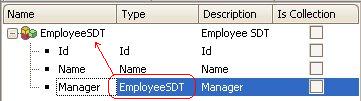
Note that this is a Recursive SDT. Then, a Data Provider receiving the employee will solve the problem:
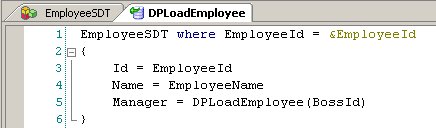
Where:
Output: EmployeeSDT

Collection: False

Parm( &EmployeeId );
This is a recursive Data Provider. DPLoadEmployee is calling itself to fill the recursive member of the EmployeeSDT. For example, the XML output (DPLoadEmployee( 123 ).toXML()) would be:
 <EmployeeSDT>
    <Id>123</Id>
    <Name>John Doe</Name>
    <Manager>
        <Id>99</Id>
        <Name>Mary Shelley</Name>
        <Manager>
            <Id>69</Id>
            <Name>Ernest Jackson</Name>
            <Manager></Manager>
        </Manager>
    </Manager>
<EmployeeSDT>
Now suppose that given an employee, you have to Output all his/her subordinates (direct or indirect), as shown below:
<SubEmployees>
   <Employee>
      <Id>99</Id>
      <Name>Mary Shelley</Name>
      <Subordinates>
         <Employee>
            <Id>123</Id>
            <Name>John Doe</Name>
            <Subordinates>
	       ...
	    </Subordinates>
         </Employee>
         <Employee>
            <Id>150</Id>
            <Name>Camile Green</Name>
            <Subordinates>
               ...
            </Subordinates>
         </Employee>
         ...
      </Subordinates>
   </Employee>
   <Employee>
      ...
   </Employee>
   ...
</SubEmployees>
This can be easily done with a Data Provider.
First, it is necessary to define the Output structure (this is done using an SDT):
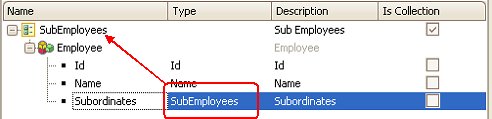
Second, the Data Provider itself is:
Name:   DPLoadSubordinates
Output: SubEmployees
Rules:  parm(&BossId)

SubEmployees
{
   Employee
   {
      Id   = EmployeeId
      Name = EmployeeName
      Subordinates = DPLoadSubordintates( EmployeeId )
   }
}
Note that this is a recursive Data Provider (DPLoadSubordinates is calling itself).